
Rat Mitigation Zone Report: January 2025 to June 2025
The NYC Health Department (Department) submits this report pursuant to NYC Administrative Code 17.133.3 to detail rat mitigation efforts in the Rat Mitigation Zones (RMZ). As required, this report includes:
- The metrics the Department is using to measure the efficacy of rat mitigation in such zones, including a description of whether the Department has seen improvement, as measured by such metrics, and, if so, how such improvement has been achieved;
- An overview of the current and planned rat mitigation measures, including goals and specific benchmarks and timelines, in each such zone;
- A description of the public outreach measures undertaken by the Department in relation to rat mitigation in each such zone;
- Explanations of the creation or elimination of rat mitigation zones, or any change of boundaries of such zone, since the previous report, if applicable; and
- Explanations of any changes to the rat mitigation measures used in each such zone since the previous report, if applicable.
Introduction
The Department’s rat control program takes a multi-pronged, evidence-based approach across New York City that builds on our decades of experience. We know that rats thrive when they have ready access to food, water, a place to live, and effective transportation routes. Reducing the rat population, therefore, requires managing garbage, eliminating nesting areas and sealing cracks and holes in sidewalks and buildings. Our approach, called Integrated Pest Management (IPM) includes:
- Inspecting properties to identify areas with rat activity, by conducting:
- Proactive inspections of every property in a particular area enable the Department to learn where rat activity is greatest and monitor progress over time.
- Complaint-based (reports to 311) inspections to address New Yorkers’ concerns of rat activity and conditions supporting rats.
- Implementing prevention and control activities by:
- Ordering property owners to remove conditions on their property that support rats and to hire a licensed pest management professional to conduct extermination.
- Conducting extermination by licensed pest management professionals on private properties when the owner fails to follow the Order and billing for the service.
- sealing and collapsing rat burrows in public property (street areas, street trees, gardens, public spaces) by a stoppage team to remove conditions conducive to rats. Providing technical assistance, monitoring, and agency referrals regarding city-owned properties like parks, schools, shelters, and public housing.
- Engaging the public by offering:
- Free “Rat Academy” training to the public and other agencies.
- Print and digital educational materials for multiple audiences in multiple languages available on our Rat Information Portal (www.nyc.gov/rats).
- Case management for properties failing to remediate rats or conditions attracting rats.
- Information at health fairs and community events and community walkthroughs.
- Sharing data on the Rat Information Portal and Environment and Health Data Portal.
- Collaboration with other city agencies and City Hall to coordinate IPM efforts across neighborhoods and in the public realm by:
- Surveying public schools, parks, and NYCHA developments for rat activity
- Offering training and technical assistance to agencies
- Meeting monthly to review challenges and coordinate solutions at the neighborhood level
Rat Mitigation Zones
The Department’s inspection data shows that rat activity in NYC neighborhoods is not equally distributed. Some neighborhoods bear a higher burden of rat infestation. Those neighborhoods tend to be densely populated, have high foot traffic, have an abundance of food service establishments, and a higher proportion of city-owned property. To effectively address rats, city agencies, property owners, and residents in these areas must work together. Rats do not observe property lines or distinguish between public and private ownership. To reduce rat populations in New York, everyone in a neighborhood, both private and public, must work together, across our usual boundaries and in times and places that matter most to rats.
The areas of the city found to be the most infested need intensive inter-agency support to address the underlying (both structural, and behavioral) conditions that support high rat populations. The Department refers to these areas as Rat Mitigation Zones (RMZs). In 2023, Local Law 110 required the Department to codify RMZ designations using certain criteria. The Department promulgated an agency regulation on July 7, 2023, and designated four RMZs: the Grand Concourse neighborhoods in the Bronx; Bushwick, Bedford Stuyvesant, and Prospect Heights in Brooklyn; West, Central, and East Harlem; and the East Village, Lower East Side, and Chinatown in lower Manhattan. Table 1 describes the four RMZs. These zones consist of 37,545 properties (tax lots), including city-owned properties that are routinely surveyed (209 parks, 79 NYCHA developments, and 184 schools).
The report summarizes data for the first five 6-month rounds (January 2023 - June 2025) of inspections and interventions in the four RMZs since implementation of Local Law 110.
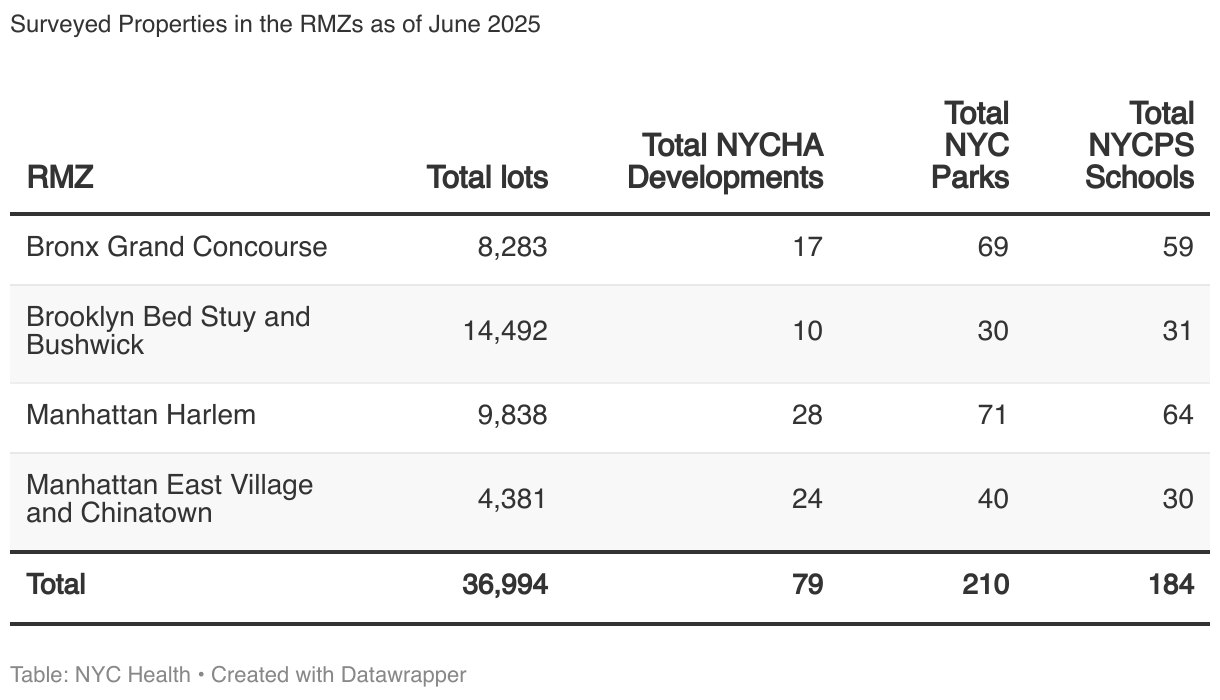
1. The metrics the Department is using to measure the efficacy of rat mitigation in such zones, including a description of whether the department has seen improvement, as measured by such metrics, and, if so, how such improvement has been achieved.
The Department is using the following metrics to measure the efficacy of rat mitigation efforts.
- Commissioner orders to abate (COTA). The number and percentage of initial inspections for properties within a given area (RMZ) that resulted in a COTA issued by the Department pursuant to section 151.02 of the Health Code in each 6-month period from January 2023 to June 2025.
- Summonses. The number and percentage of compliance or follow up inspections for rat activity for private properties within an RMZ that have resulted in the issuance of a summons pursuant to section 151.02 of the Health Code in each 6-month period from January 2023 to June 2025.
- Rat Exterminations and Stoppage visits. The number of rat baiting and stoppage visits by the Department extermination team at properties within a RMZ in each 6-month period from January 2023 to June 2025, executed by the Department pursuant to section 17-147 of the Administrative Code following a failure to comply with an order issued pursuant to section 151.02 of the Health Code.
- City agency referral letters. The number and percentage of inspections for city-owned properties within a RMZ that resulted in the issuance of a city agency referral letter by the Department in each 6-month period from January 2023 to June 2025.
- Reports to 311. The number and nature of 311 requests for service or complaints related to rat activity within each 6-month period from January 2023 to June 2025.
A COTA is sent to a private property owner when an initial inspection identifies any Health Code violation at the time of inspection including garbage conditions, harborage conditions, or any active rat signs. The COTA includes an inspection report and the follow-up actions expected of the property owner.
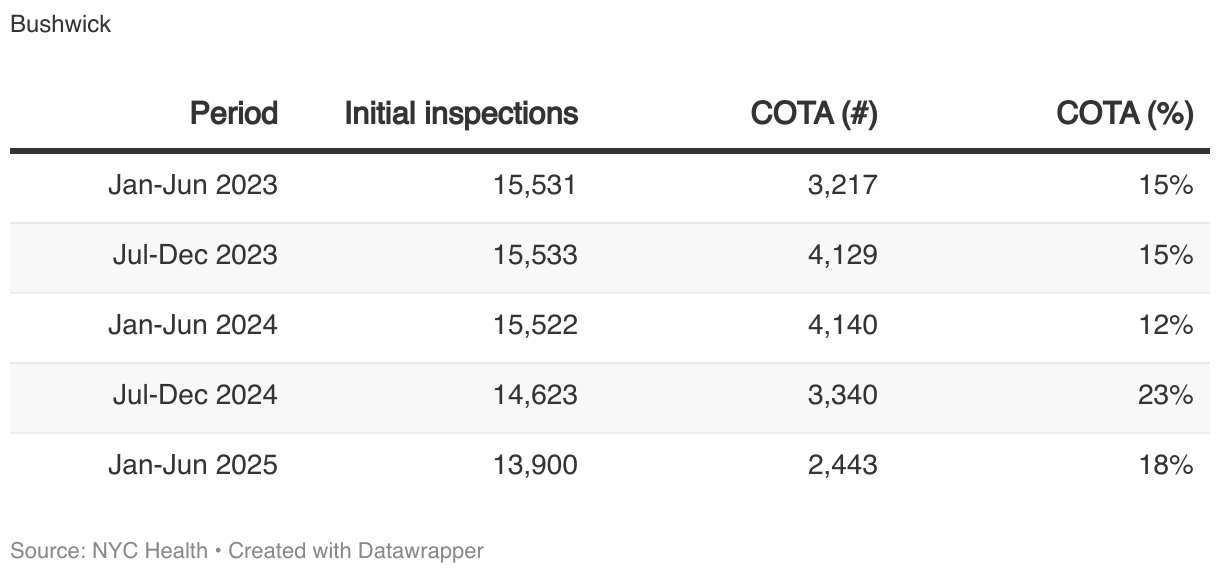
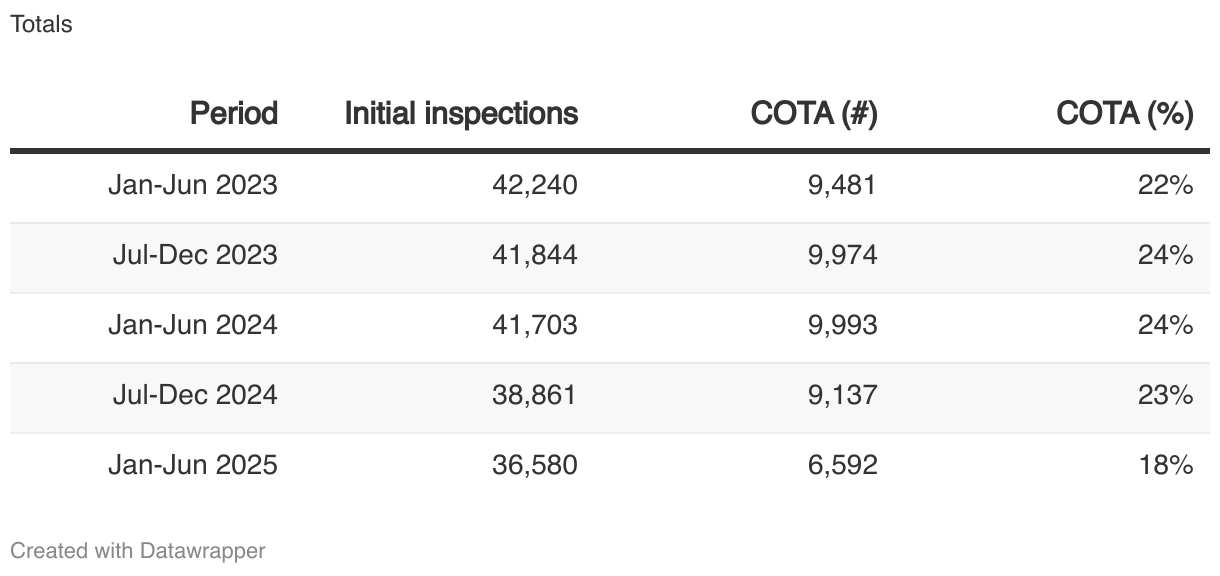
Overall, in the first six months of 2025 in the four RMZs, the Department issued 6,583 COTAs (18% of 36,263 initial inspections) to private property owners (Table 2). The Department conducted 5,000 fewer initial inspections in the first half of 2025 (36,580) as compared to the same period in 2024 (41,703) because of a shift in the program’s strategy to elevate compliance inspections on properties with repeated failed inspections, instead of performing a new initial inspection (described below in Summonses section). The percent of initial inspections that resulted in a COTA decreased (24% in 2024 compared to 18% in 2025). This decrease is seen in the Bronx Grand Concourse (from 30% in January to June 2024 to 26% in January to June 2025), Brooklyn Bed Stuy/Bushwick RMZ (27% in January to June 2024 to 18% in January to June 2025) and Harlem RMZ (21% in January to June 2024 to 14% in January to June 2025). Both the Harlem and the Brooklyn RMZs had the lowest failure rate on initial inspection in January to June 2025 when compared to the previous four rounds. Percent of inspection that resulted in a COTA increased in the East Village/Chinatown RMZ (from 12% in January to June 2025 to 14% in January to June 2025).
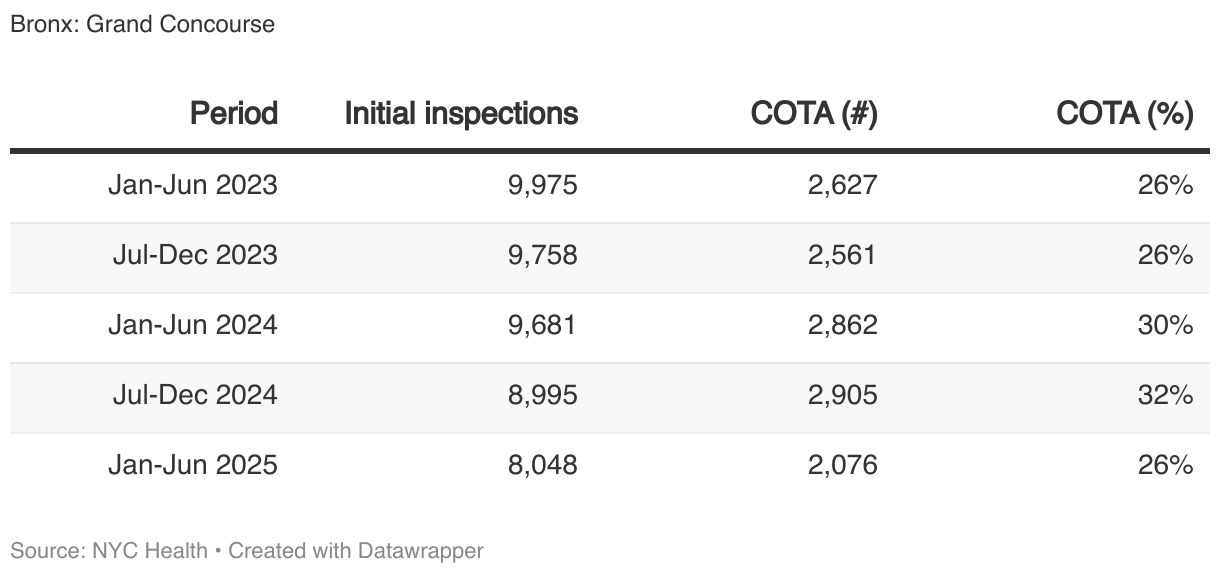
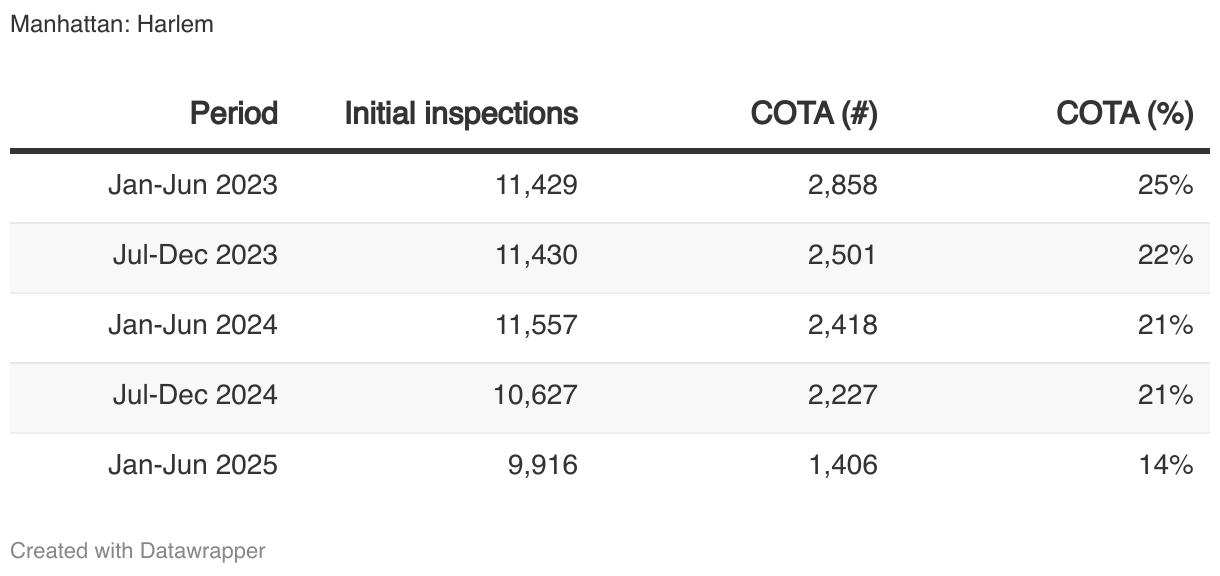
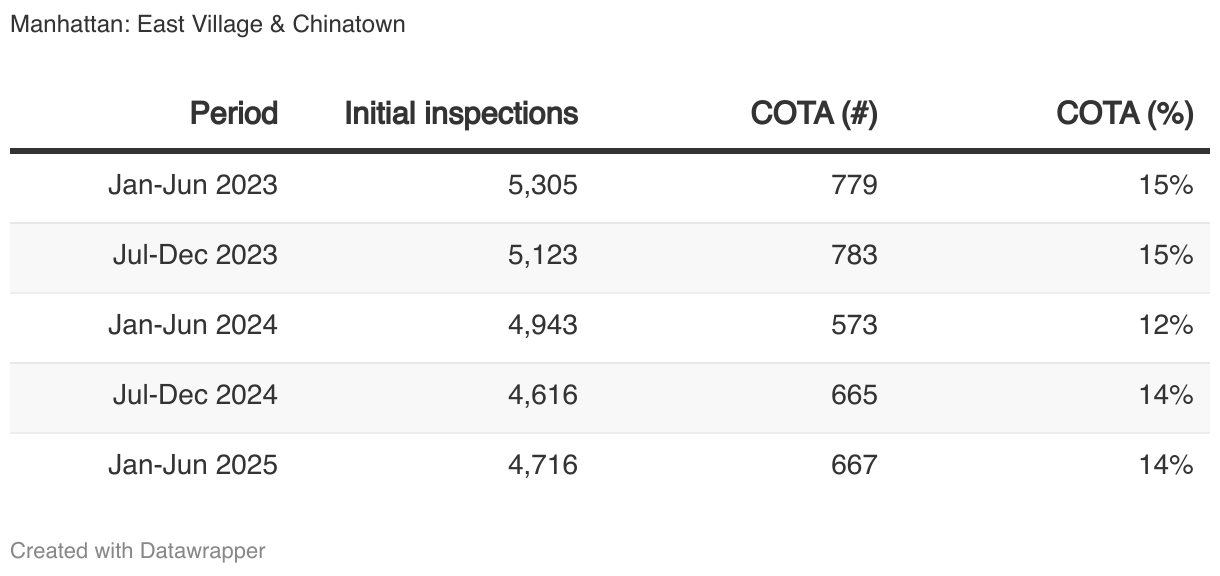
Within about four weeks of the COTA being mailed to the owner of a private property, an inspector will conduct a follow-up (compliance) inspection. If the inspection identifies any Health Code violation, the property fails the compliance inspection and the Department issues one or more summons subject to fines to the owner of the property.
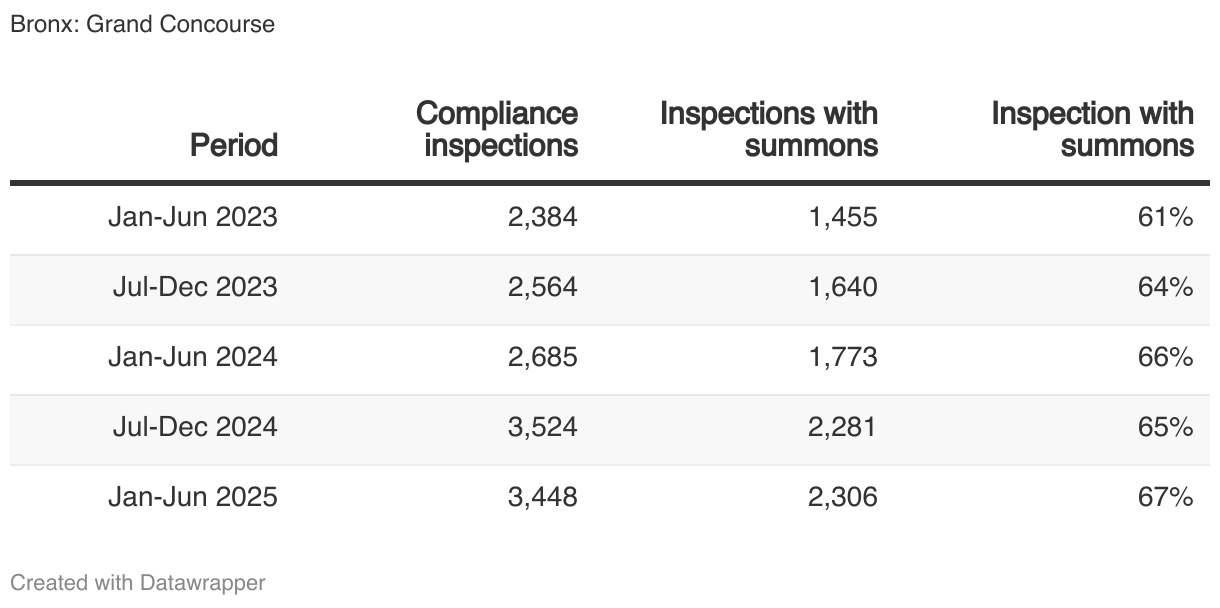
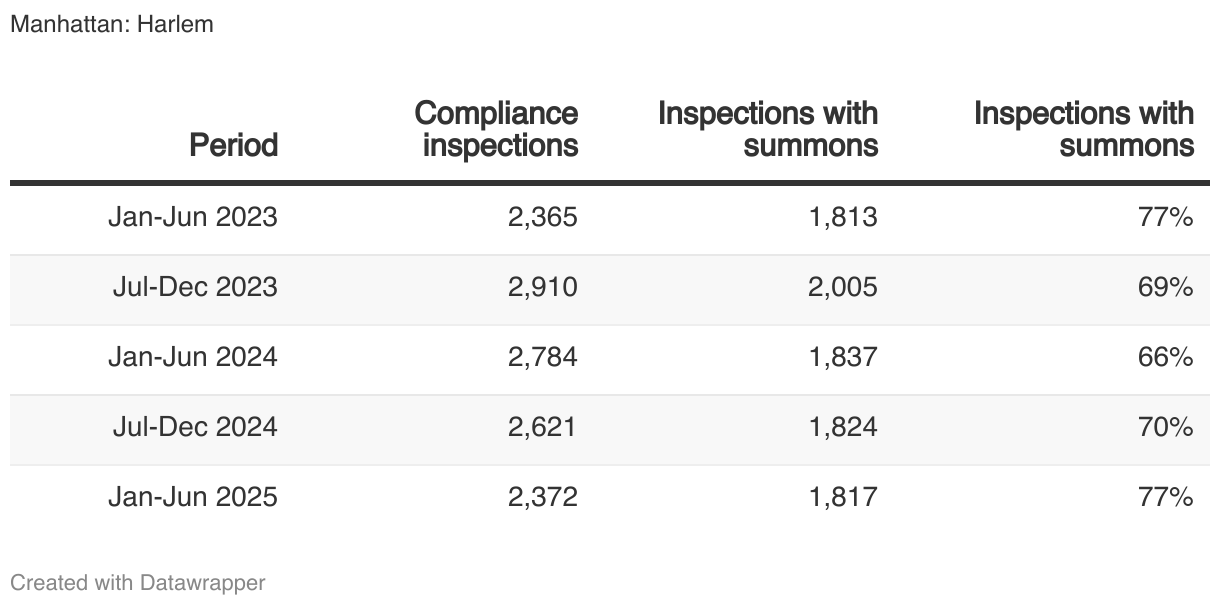
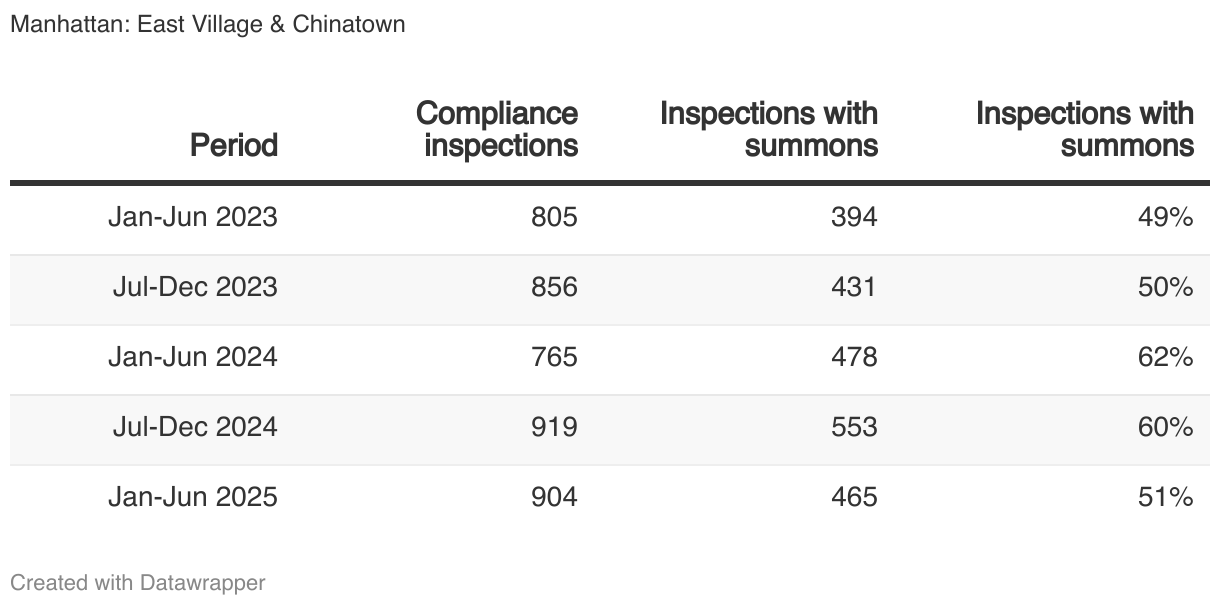
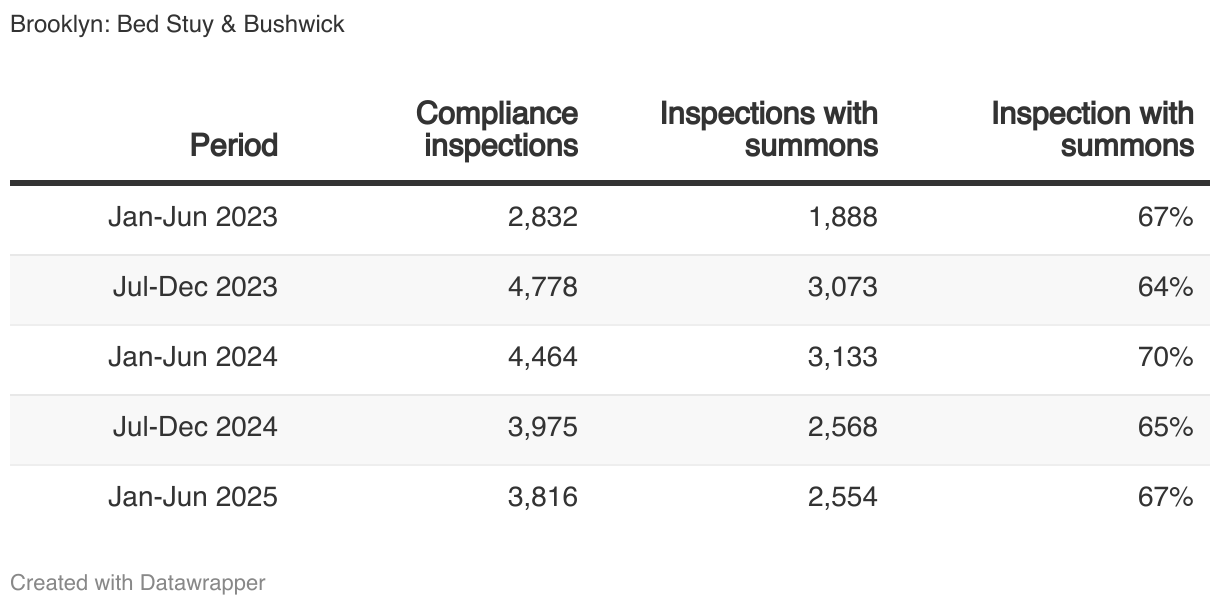
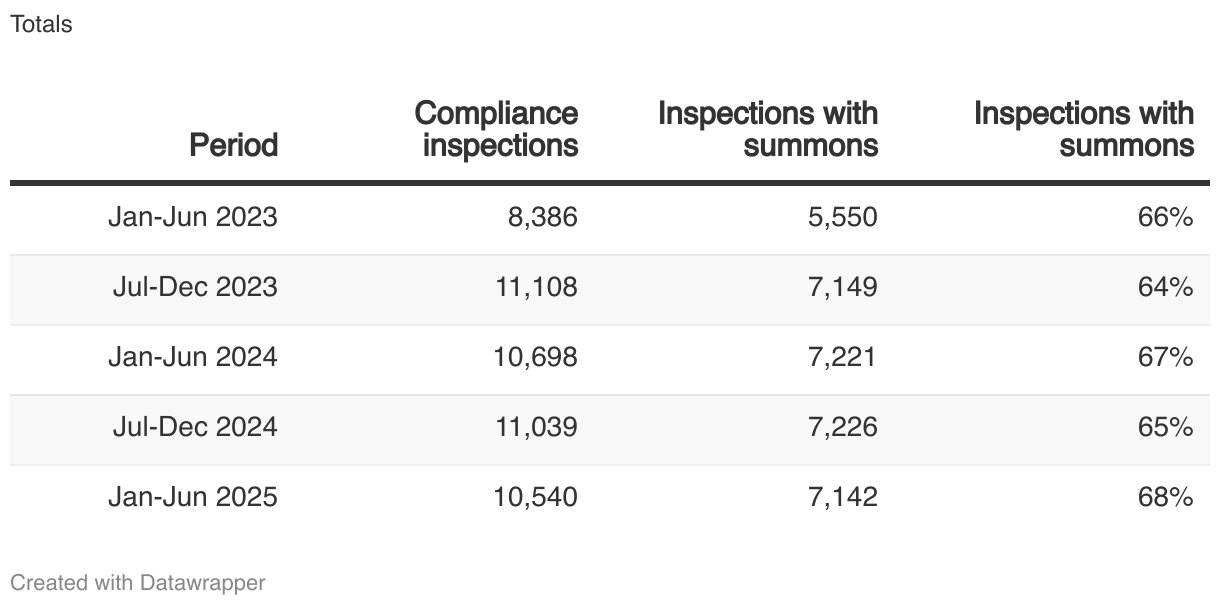
Table 3 shows the total number of compliance inspections for each RMZ in a 6-month period and the number of failed inspections where a summons or summonses were issued (this includes repeat elevated compliance inspections on properties that failed multiple times). In the first six months of 2025 in the four RMZs, the total inspections with a summons(es) issued was 7,142 (68% of 10,540 compliance inspections), which is very similar to the number of summons(es) issued in 2024 (7,221, 67% of 10,698). In Brooklyn and East Village/Chinatown, the percent inspections with summons(es) decreased compared to January to June 2024, with the largest decrease in East Village/Chinatown (Brooklyn from 70% to 67%; East Village/Chinatown from 62% to 51%). In Harlem and the Bronx, the percent of inspections with summons(es) increased (Bronx from 66% to 67%; Harlem from 66% to 77%).*
The Department conducts “elevated compliance inspections” on properties that have repeated failures. Violations issued on elevated compliance inspections result in higher fines. As of late 2024, the Department has focused on elevated compliance inspections in an effort promote compliance. The focus on elevating compliances is part of a strategy to address large, high-income buildings that pay fines as a cost of doing business rather than abating their rat conditions and making improvements on the building.
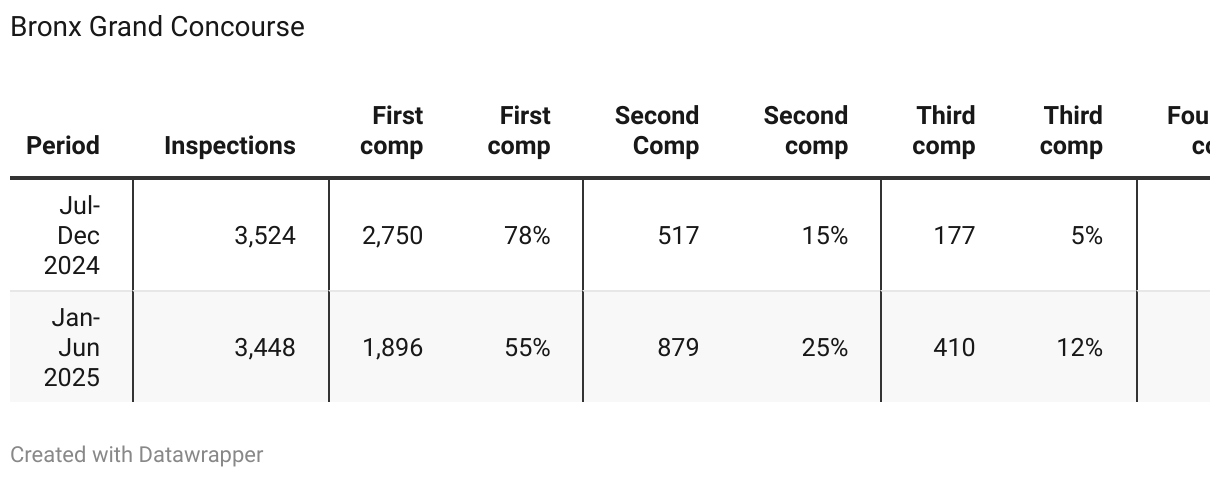
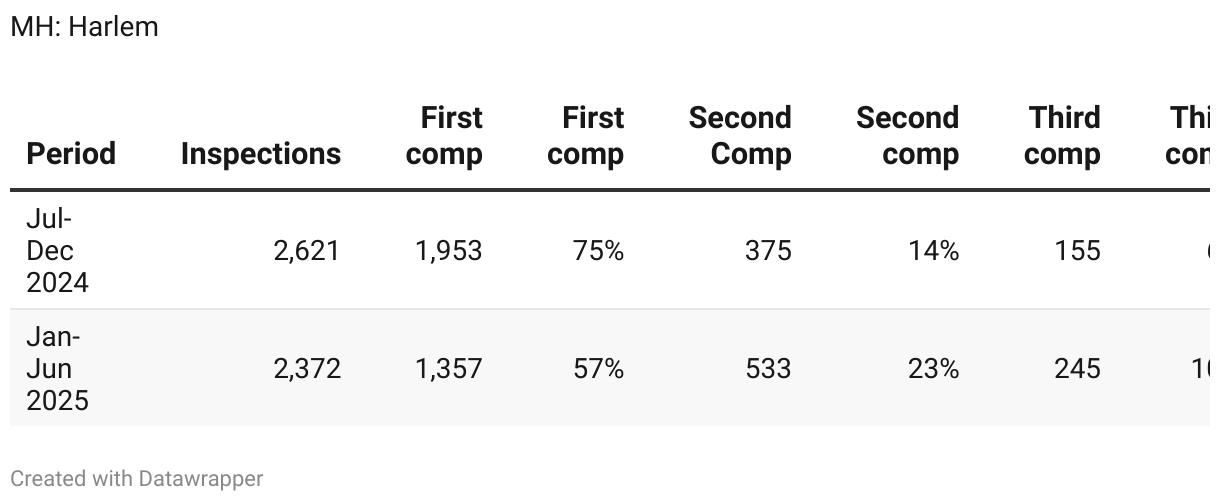
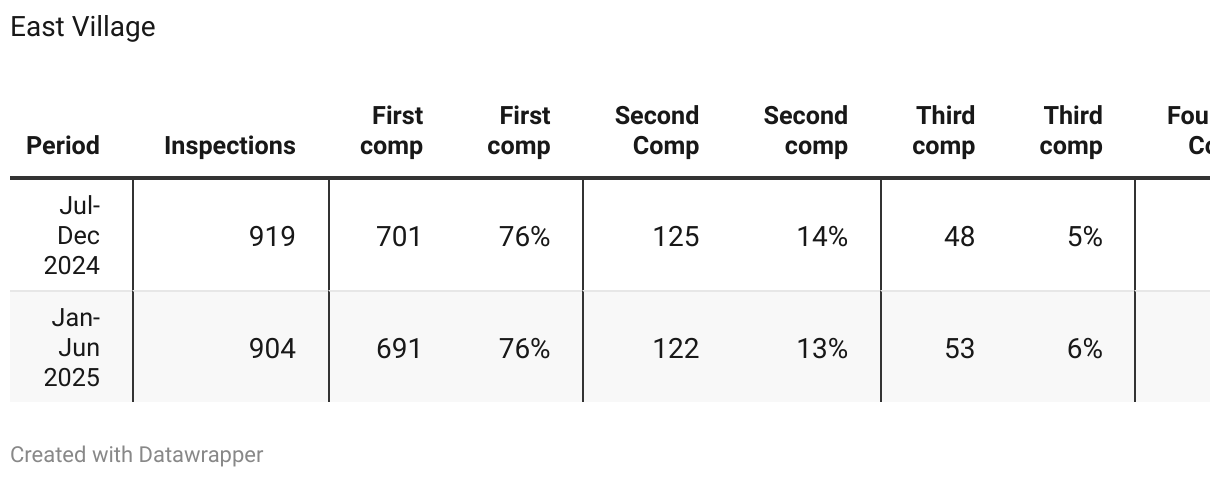
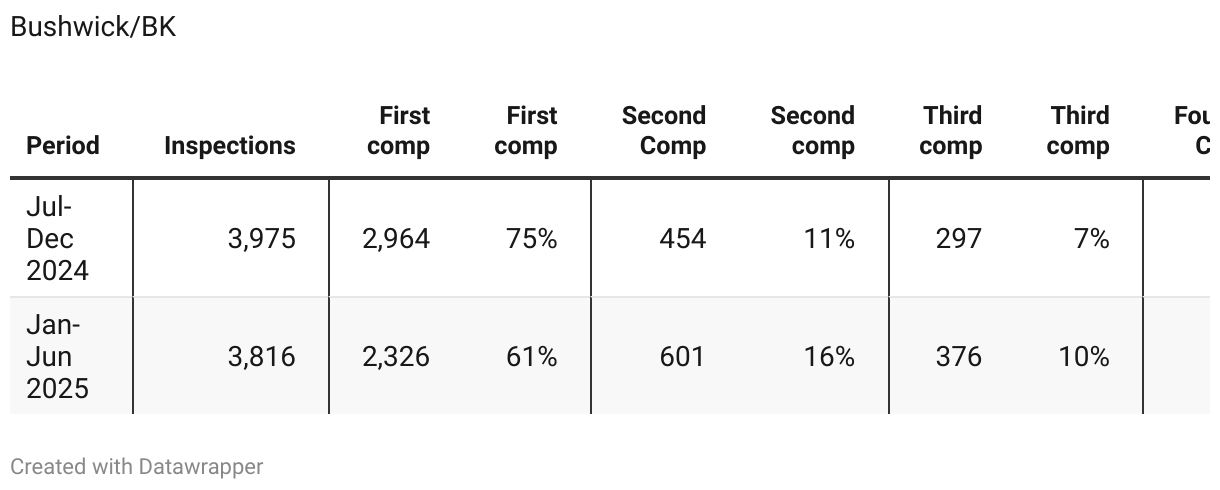
Table 3a shows the total number of compliance inspections for each RMZ in a 6-month period and the breakdown by compliance elevation. In all zones except East Village/Chinatown, there is a shift in compliance elevation from first compliance inspections to higher compliances (Bronx went from 22% second or higher compliances in July to December 2024 to 45% in January to June 2025; Brooklyn went from 25% in July to December 2024 to 39% in January to June 2025; Harlem went from 25% in July to December 2024 to 43% in January to June 2025). Elevated compliances in East Village/Chinatown remained approximately the same between July to December 2024 to January to June 2025.*
III. Rat Exterminations
Property owners are required to maintain their property free of rats and the conditions that are conducive to rats. In cases where owners fail to treat rats on their property, the Department may act by treating the private property and billing the owner for the work.
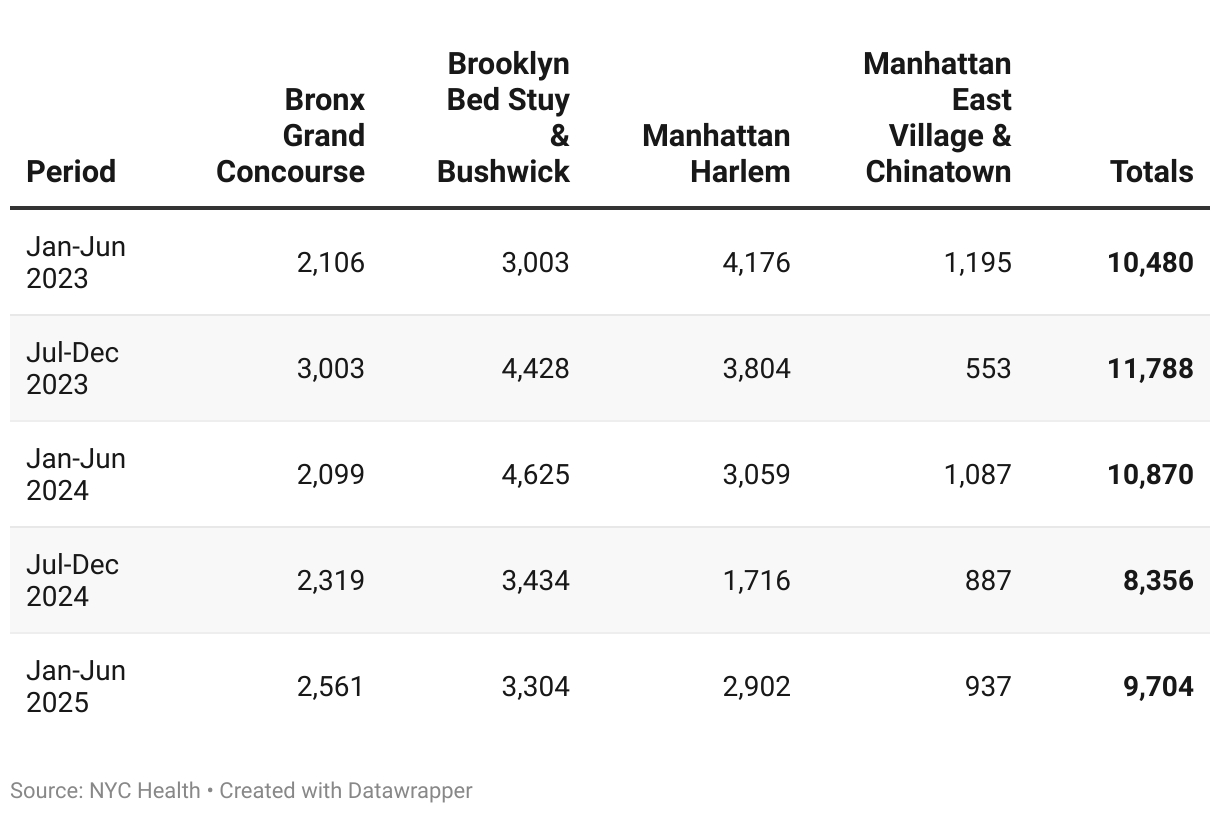
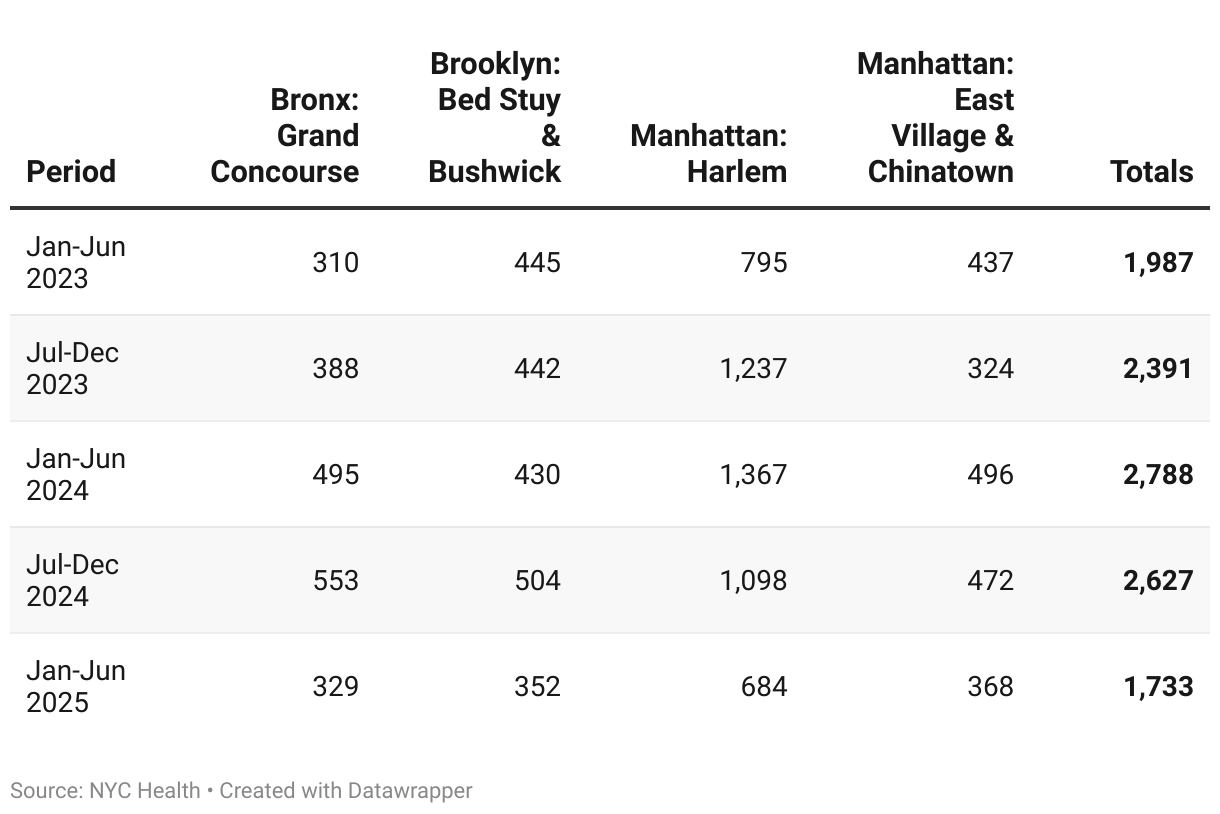
Tables 4 and 4a provide a count of treatment visits by the Department extermination team and the stoppage team. The total number of extermination visits in the four RMZs was 9,704, slightly less than the number of extermination visits in January to June 2024. By RMZ, the number of extermination visits is approximately the same in Harlem (around 3,000 visits for both January to June 2024 and 2025) and East Village/Chinatown (around 1,000 visits for both 6-month periods), but notedly decreased in Brooklyn Bed Stuy/Bushwick (4,625 visits in January to June 2024 to 3,304 in January to June 2025) and increased in Bronx Grand Concourse (2,099 visits in January to June 2024 to 2,561 in January to June 2025). The number of stoppage visits decreased in all zones.
IV. City agency referral letters
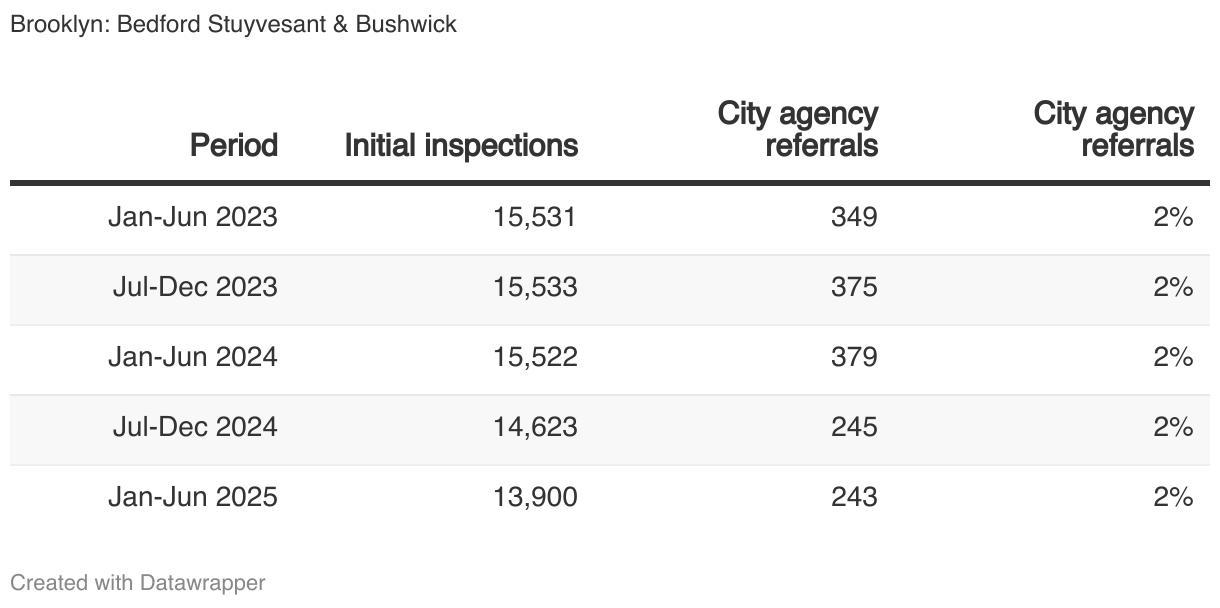
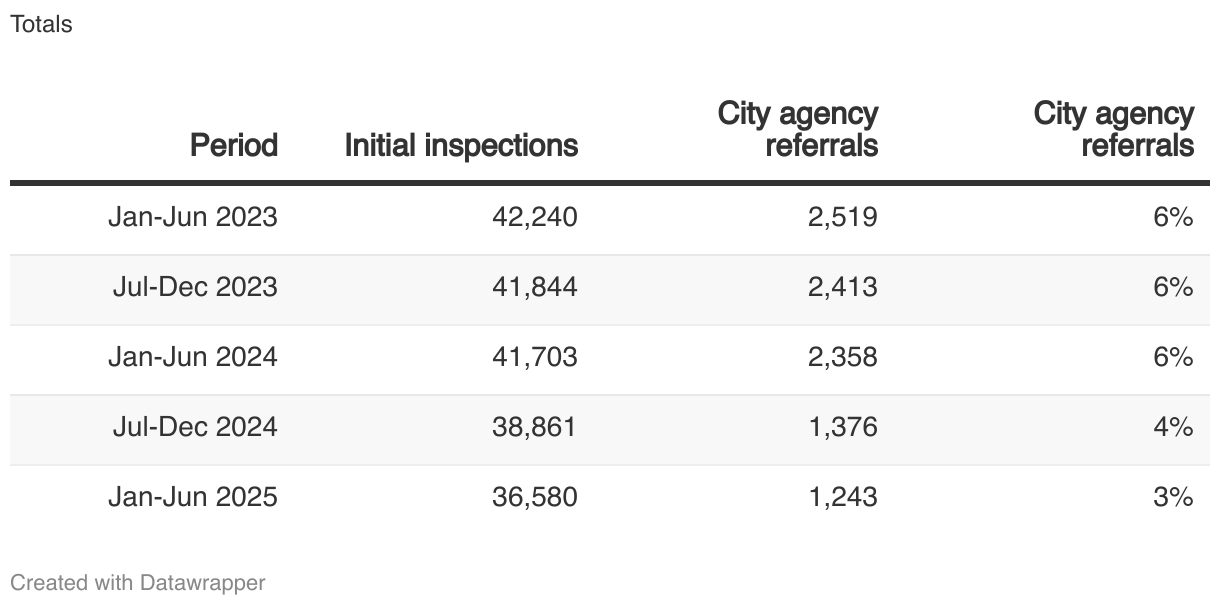
city agency referral is sent to a city agency when an inspection identifies any Health Code violation at the time of inspection on a property they own or manage.
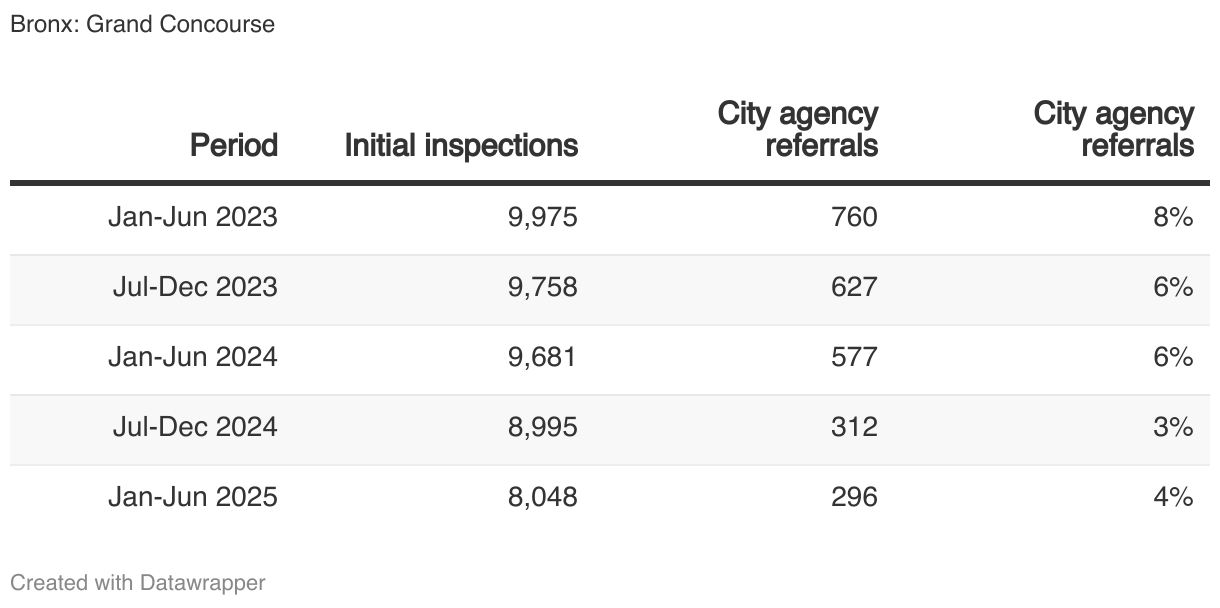
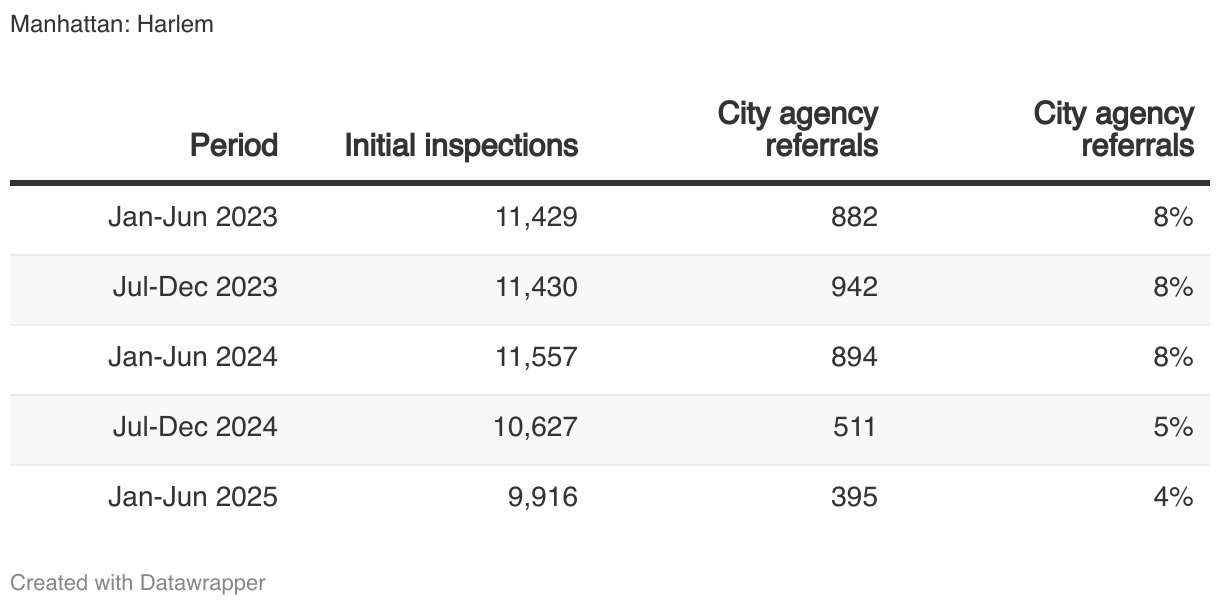
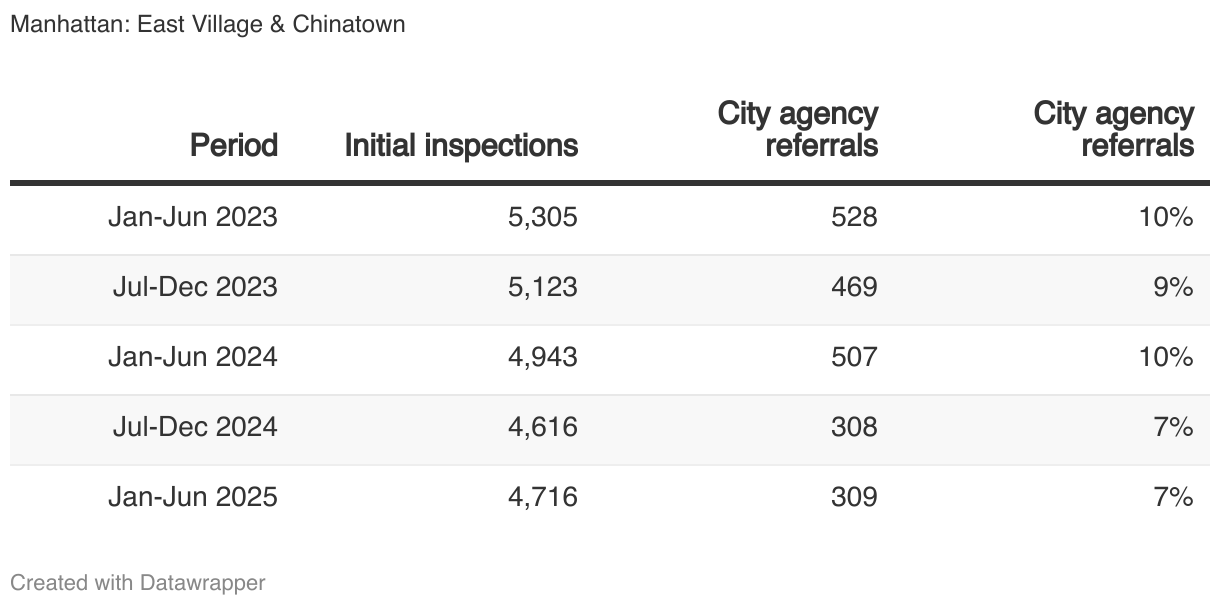
In the first six months of 2025 in the four RMZs, 1,243 city agency referrals (3% of 36,580 initial inspections) were sent to city agencies (Table 5). The percent of inspections that resulted in a city agency referral decreased from January to June 2024 and January to June 2025. The percent of inspections resulting in a city agency referral remained the same in Brooklyn Bed-Stuy/Bushwick (2% in both 6-month periods), but decreased in all other zones (Bronx Grand Concourse from 6% January to June 2024 to 4% January to June 2025; Harlem from 8% January to June 2024 to 4% January to June 2025; East Village/Chinatown from 10% January to June 2024 to 7% January to June 2025).*
a. Susceptibility to rat infestation.
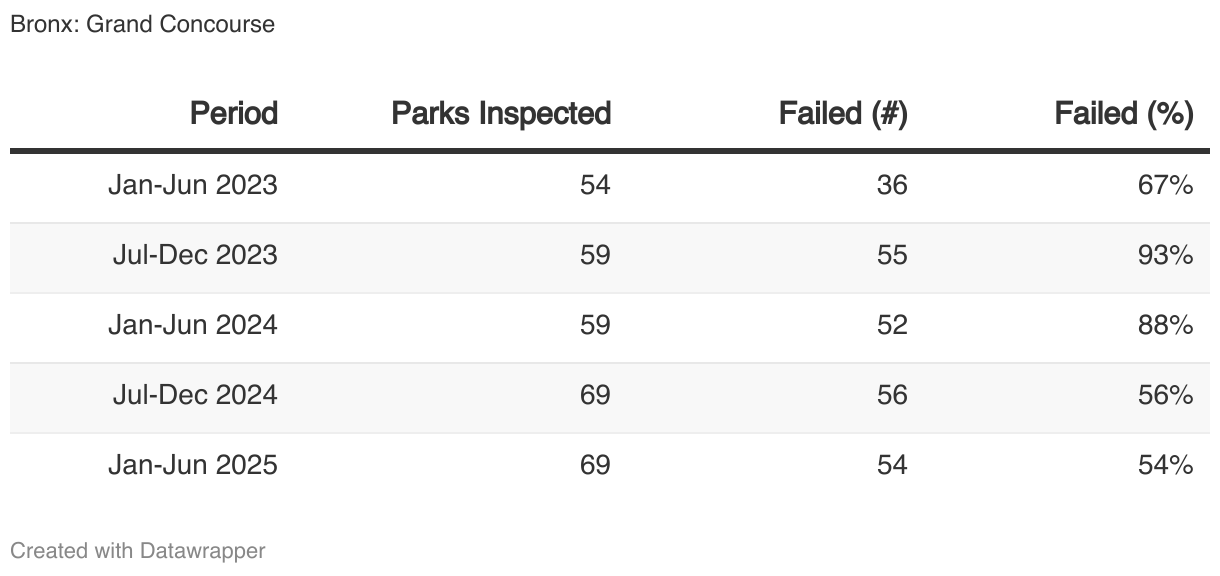
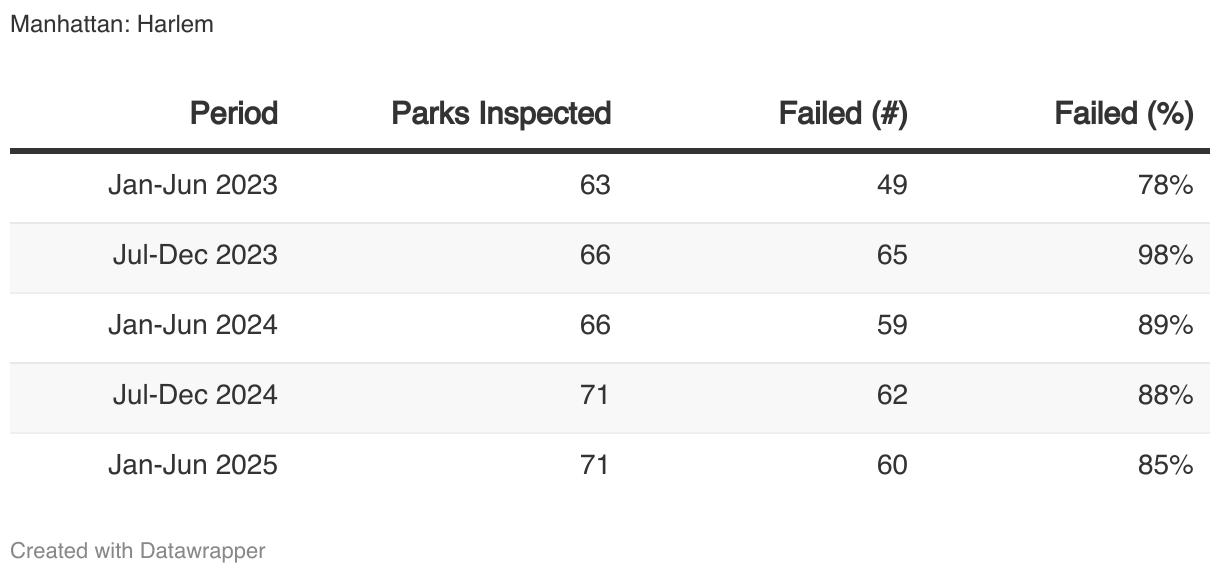
Properties that are managed by the New York City Department of Parks and Recreation (NYC Parks) are heavily used for multiple recreational purposes, many of which can result in creating food sources for rats. Combined with the ample earthen spaces that rats love to burrow in, parks are very attractive to rats and uniquely susceptible to them. These properties are routinely inspected by the NYC Health Department.
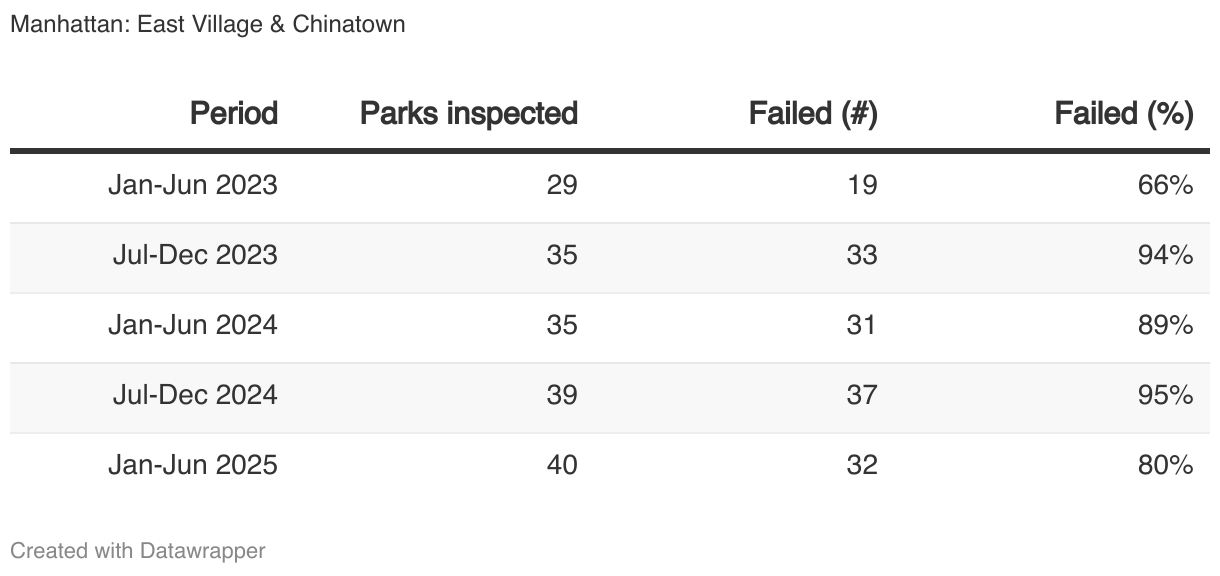
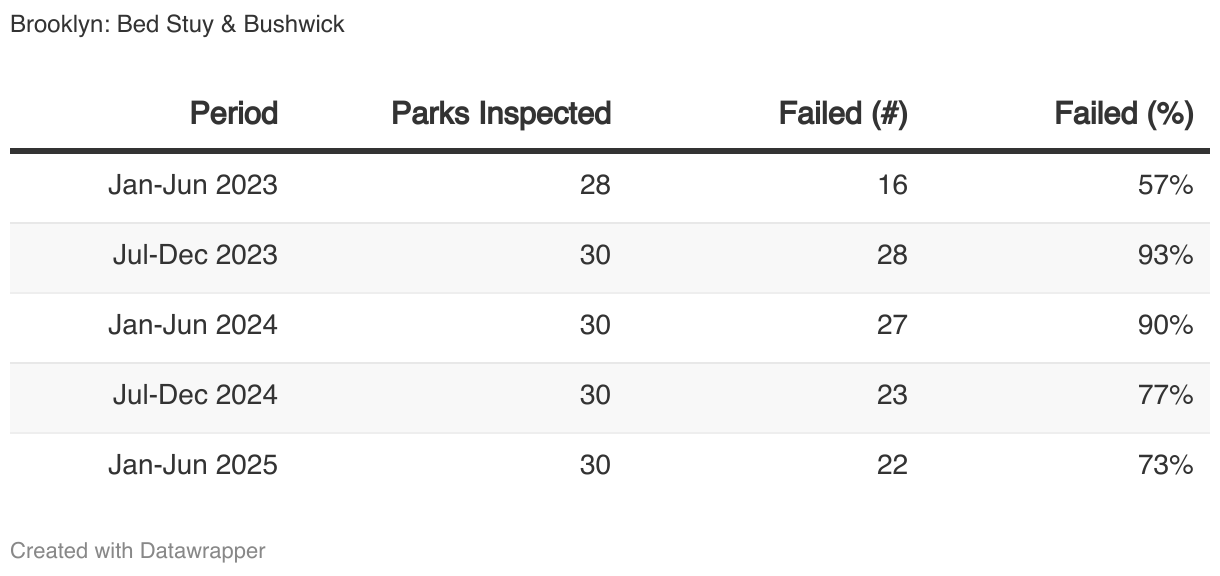
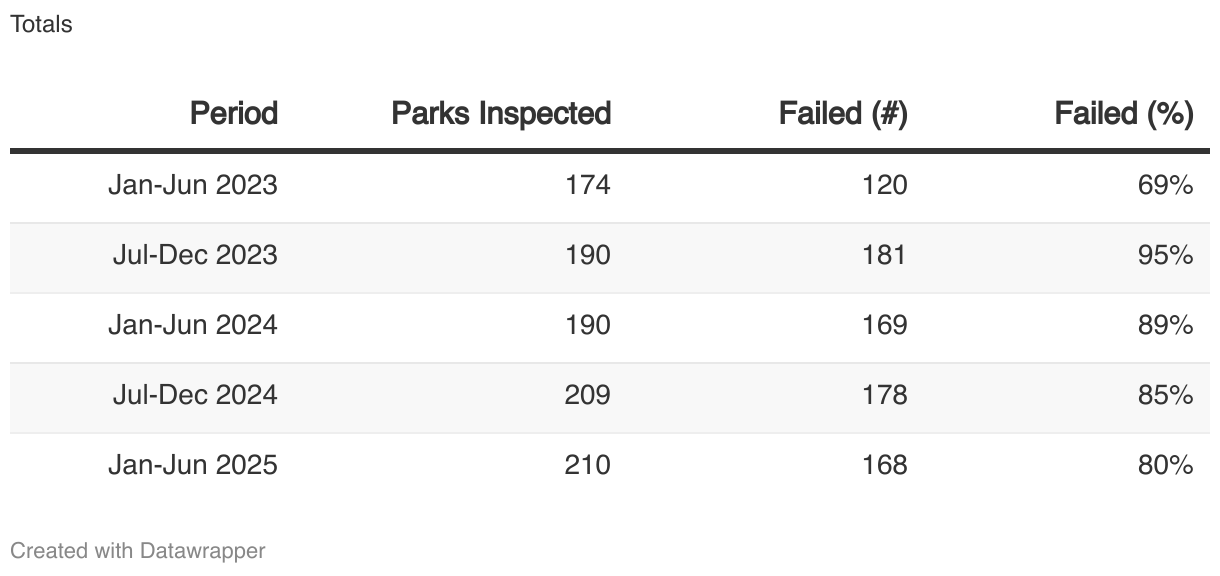
In the first six months of 2025 in the four RMZs, 168 NYC Parks properties failed initial inspection (80% of 210 properties) (Table 5a). The percent of properties that failed initial inspection decreased from 89% in January to June 2024 to 80% in January to June 2025. This pattern was seen consistent across the four RMZs (Bronx from 88% to 78%; Brooklyn from 90% to 73%; Harlem from 89% to 85%; East Village/Chinatown from 89% to 80%).
V. Reports to 311
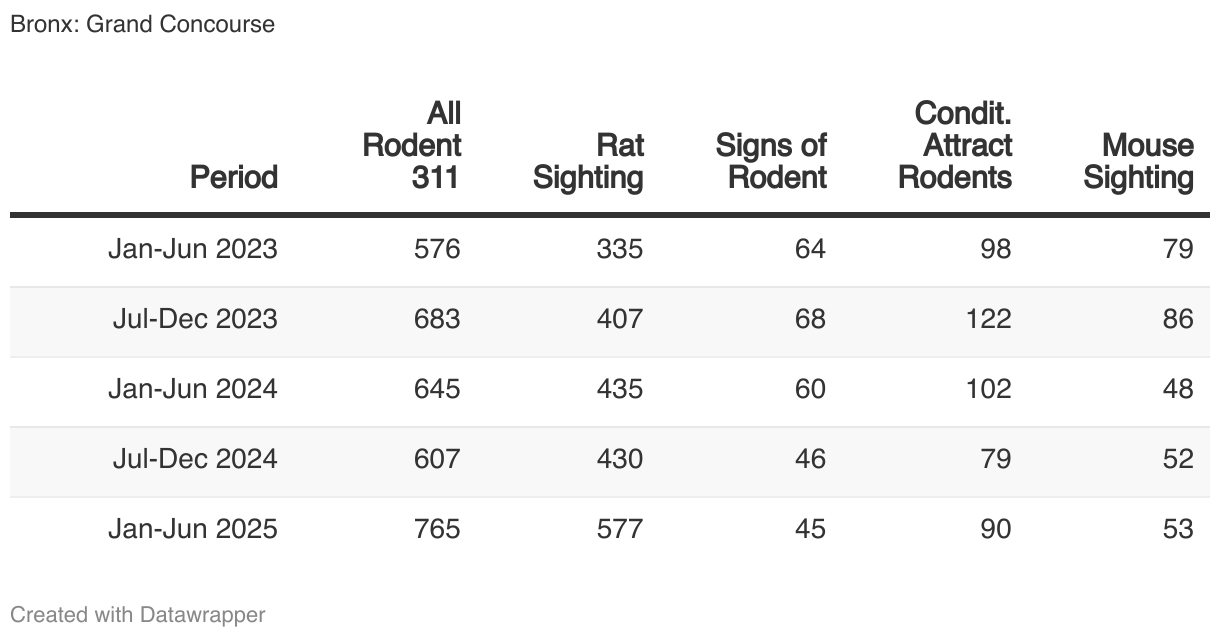
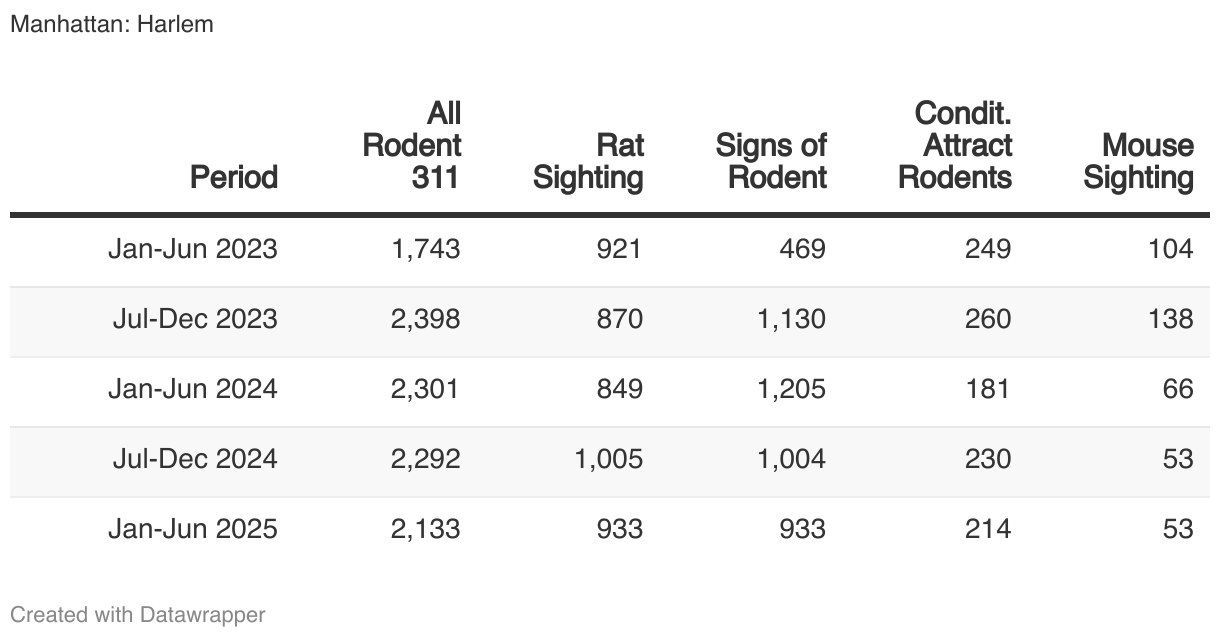
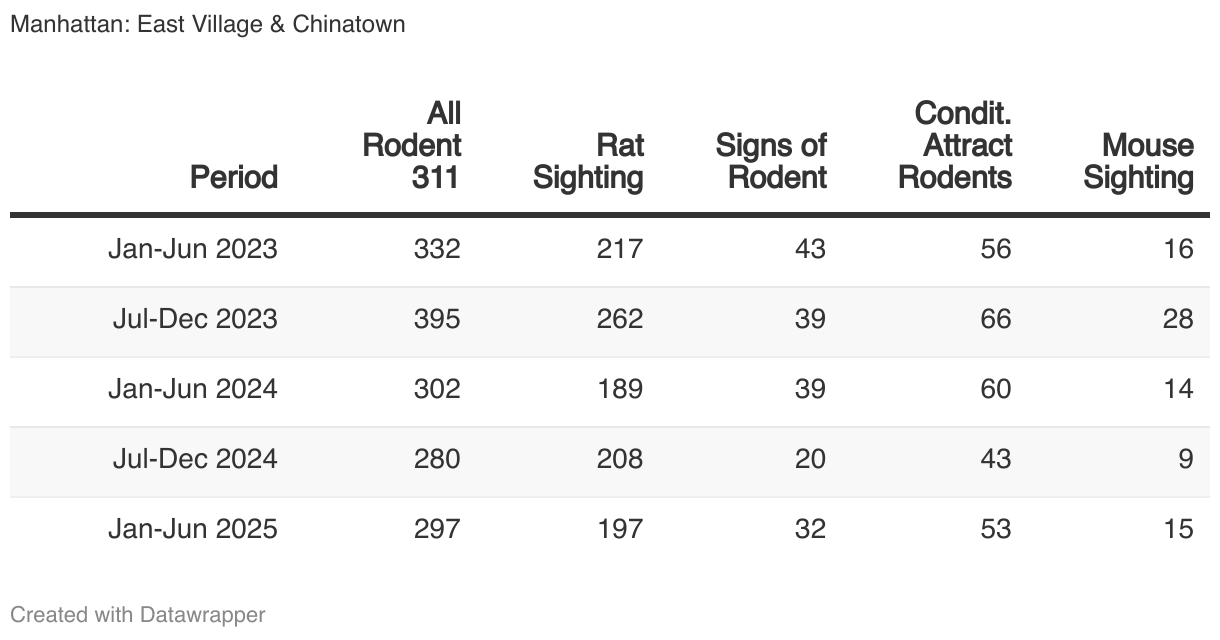
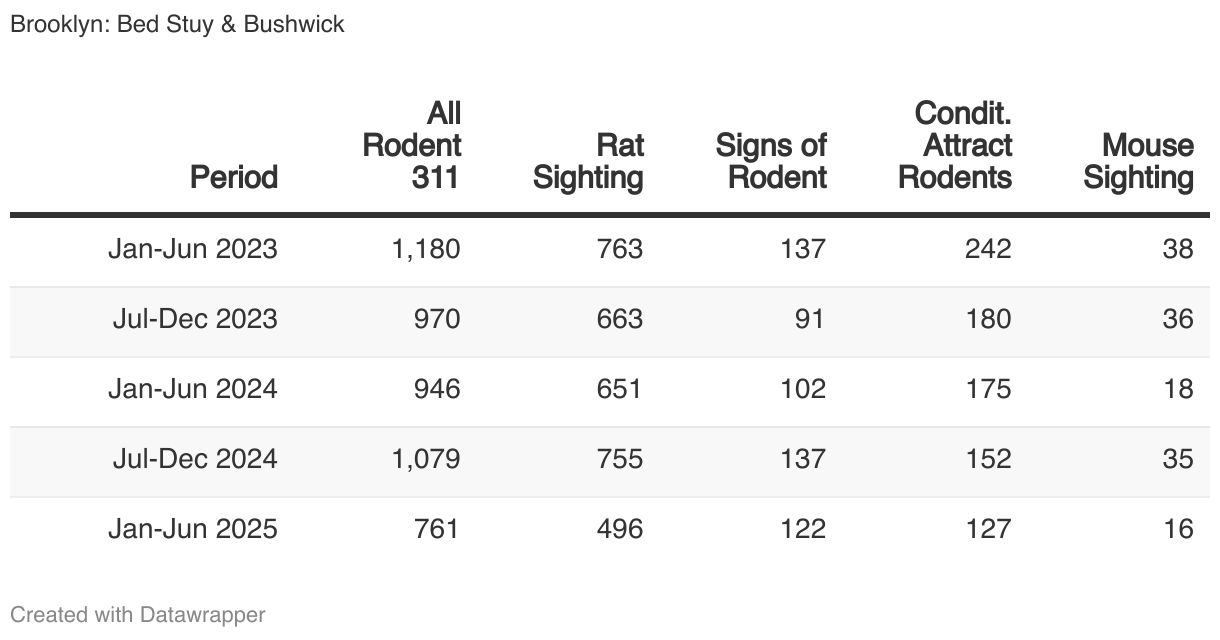
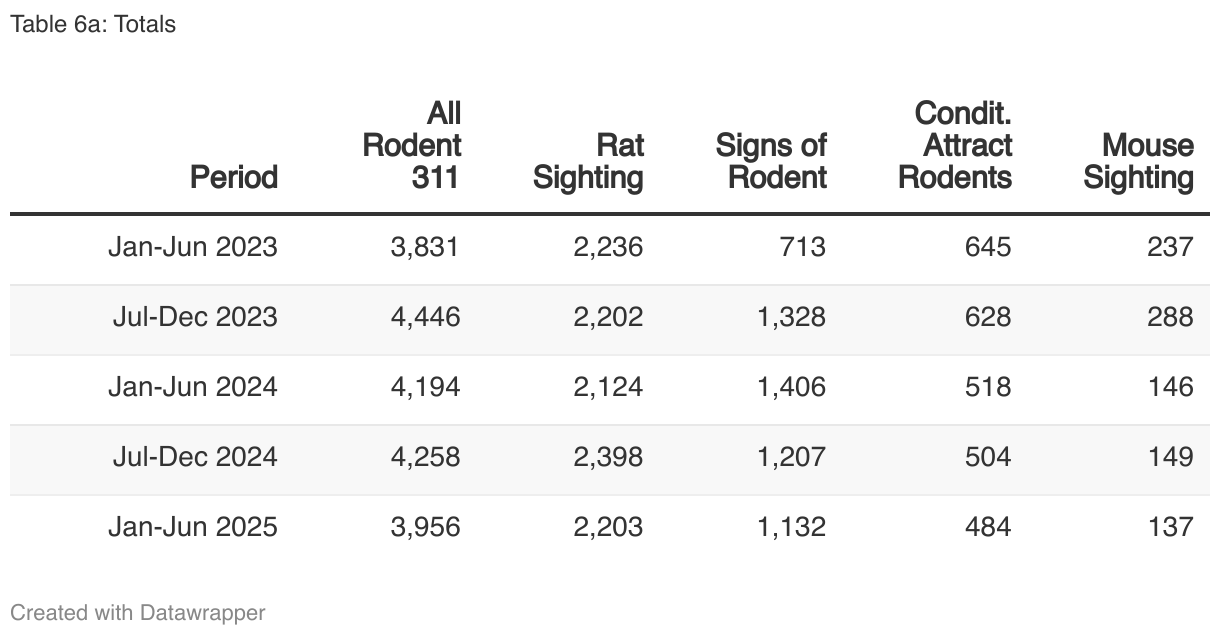
Tables 6 and 6a show the number of 311 complaints received by the Health Department in each of the four RMZs for overall rodent-related complaints and for the descriptors of rat sighting, signs of rodent and conditions attracting rodents over a 6-month period from January 2023 to June 2025. Comparing 2024 to 2025, rodent complaints across the four RMZs decreased from 4,194 in January to June 2024 to 3,956 January to June 2025 (Table 6a), with the most notable decrease in Brooklyn Bed Stuy/Bushwick (from 946 311 complaints in January to June 2024 to 761 in January to June 2025) and Harlem (from 2,301 complaints in January to June 2024 to 2,133 in January to June 2025) (Table 6). In Brooklyn Bed Stuy/Bushwick, this decrease in overall rodent complaints is driven by decreases in rat sightings (from 651 complaints in January to June 2024 to 496 complaints in January to June 2025) and conditions attracting rodents (from 175 in January to June 2024 to 127 in January to June 2025). Complaints for signs of rodents and mouse sightings remained relatively similar between the two years. In Harlem, the decrease in rodent complaints is driven by signs of rodents (from 1,205 complaints in January to June 2024 to 933 complaints in January to June 2025), with increased complaints in rat sightings (849 complaints in January to June 2024 to 933 complaints in January to June 2025) and conditions attracting rats (181 complaints in January to June 2024 to 214 complaints in January to June 2024).
2. Current and planned rat mitigation measures
Initial inspections are both proactive (each property in the RMZ is inspected twice a year) and reactive (inspections in response to 311 complaints about a property). Each property in the four RMZs is categorized into 1 of 6 cohorts, where each cohort of properties is designed to be similar in character to the overall RMZ in terms of percent of city owned properties, percent of parks, etc. The cohort design provides three valuable sources of information: identification of individual properties with active rat signs or signs conducive to rats, a monthly snapshot of the RMZ rat activity, and rat activity across the entire RMZ every six months (referred to as a full round). This has been used by the Department as a monitoring tool. Increases in percent of inspections with active rat signs over several months can trigger an increase in enforcement, outreach or treatment in an area.
Systematic inspections of individual properties of the entire RMZ (neighborhood indexing) are essential as they allow for identification of properties with active rat signs or signs conducive to rats, especially in areas where the public underutilize the 311 complaint system. Failing inspections trigger the mailing of a COTA or city agency referral letter, which are two metrics the Department tracks. From these metrics, we see an overall decrease in percent of private property inspections that resulted in a COTA (Table 2), which is seen in all zones except East Village/Chinatown. The percent of inspections that resulted in a city agency referral letter decreased over the three RMZs (Bronx Grand Concourse, Harlem and East Village/Chinatown) and remained the same in Brooklyn from 2024 to 2025 (Table 5).
The Department uses a variety of strategies to respond to high rat activity in a neighborhood, including increasing the fine amounts for summons or summonses for properties that repeatedly fail compliance inspections, increasing extermination visits and increasing the number of community outreach activities. The goal is to decrease the percent of inspections resulting in COTAs. The Department also works closely with partner agencies on reducing the number of city agencies that fail inspections and reducing the severity of rat infestation on city-owned property, which is discussed in the section “Collaboration with NYC Parks, NYCHA and NYCPS”.
Complaint-based inspections
Initial inspections can be reactive (inspections in response to 311 complaints about a property). When a 311 rodent complaint is made for a property in the RMZ, a new inspection will be initiated if an inspection has not been performed on that property in the last three months or if the property is not currently undergoing the enforcement process that resulted from a proactive inspection. The new initial inspection will look for signs of rat activity and may result in a COTA or city agency referral, just like the proactive indexing inspections. In the RMZs, the number of all rodent complaints decreased from 2024 to 2025 (Table 6), with the most notable decreases in Brooklyn Bed Stuy/Bushwick and Harlem. The decrease in rodent complaints in Brooklyn Bed Stuy/Bushwick and Harlem mirror the decrease in percent of initial inspections resulting in COTAs. This is not the case for Bronx Grand Concourse, where the percent of inspections resulting in COTAs decreased and the number of complaints increased. The goal is to continue to respond to every complaint in a timely manner (within 14 days).
Compliance Inspections and enforcement on private properties
A follow-up (compliance) inspection is conducted on private properties that failed the initial inspection about four weeks after the COTA is mailed. If active rat signs or conditions conducive to rats are identified in the compliance inspection, the Department will issue one or more summonses with associated fines to the owner of the private property. The percent of compliance inspections with summons was approximately the same in 2024 and 2025 (Table 3), with increases noted in Harlem and Bronx Grand Concourse and decreases noted in Brooklyn Bed Stuy/Bushwick and East Village/Chinatown. With every compliance inspection, the Department’s case managers seek to improve compliance by working with property owners and managers to resolve the issues noted on inspection and giving them time to perform the remediation work. If the property owner fails to act, the case manager can repeat the compliance (elevate the compliance) on the same property, where each subsequent failed inspection elevates the associated fines. The goal is to decrease the percent of compliance inspections with summons.
Extermination Visits and Stoppage Visits by the Department
When private property owners fail to maintain their property free of rats and conditions conducive to rats during a compliance inspection, the Department may act by treating the property and billing the owner for the work. Department exterminators may also treat public spaces like tree pits, street areas, or parks on an emergency basis. Overall, extermination visits in the four RMZs decreased between 2024 and 2025 (Table 4.) The Department is working with other agencies to evaluate the types of rodent treatments used by exterminators and have started to deploy new methods and products in the past year. The Department is working to increase the use of alternative products such as carbon monoxide and carbon dioxide treatments and structural and behavioral controls for rats. The Department also launched a pilot in the Harlem RMZ to evaluate rat contraceptive products.
Collaboration with Parks, Public Housing and Schools
Under the Neighborhood Rat Reduction Initiative, the Department has collaborated with NYC Parks, NYCHA and NYCPS to assess rat activity and conditions conducive to rats in their respective properties in the four RMZ by conducting surveys at least every two months and using this data to test and evaluate rat mitigation methods, with a renewed focus on IPM. From January 2024 to June 2025, 210 parks, 79 NYCHA developments, and 184 school buildings were surveyed monthly. Metrics collected include earthen burrow counts, structural holes, other signs of rat activity, presence of garbage and/or harborage and individual agency remediation efforts. This inter-agency work is being carefully tracked in monthly Rat Task Force meetings at City Hall. The goal for all agencies is to decrease the primary metric of interest (earthen burrow count for NYCHA and NYC Parks and percent failed on survey for NYCPS) by 30%.
3. A description of the public outreach measures undertaken by the department in relation to rat mitigation in each such zone.
The Department has an active community outreach program. The outreach and education program consists of free training that can be tailored to a wide range of audiences; educational materials in multiple languages on rat reduction and prevention methods; a robust online Rat Information Portal (www.nyc.gov/rats), which provides access to both guidance materials and inspection results; and participation at community events to promote best practices in rat prevention strategies.
The Department’s “Rat Academy” offers free trainings to the public teaching IPM techniques to safely prevent and manage rats. An elected official, Business Improvement District (BID), block association, community board or community group can sponsor or host a Rat Academy training for their area, and the Department can tailor the Rat Academy curriculum to the audience and the neighborhood. Tailored Rat Academies have been presented to private property management companies, landlords, owners, businesses, urban gardeners, and city agencies. One component of the class is to teach attendees to use the Rat Information Portal to track inspections.
From January 1, 2025 to June 30, 2025, the Department offered 26 Rat Academy trainings. The trainings had a total of 1,693 unique registrants and 498 training participants. Five Rat Academy events were sponsored byelected officials, two were held for students at NYC Public Schools, and one at a private school.
Rat Academies at NYC Public Schools were followed by Rat Walks with City Hall’s Director of Rodent Mitigation and walk-through participants were invited to join the NYC Rat Pack.
The Department collaborated with NYCHA for a cleanup and Rat Academy event at Mitchel Houses in the Bronx and attended the 2025 NYCHA Farms and Gardens Summit.
Some of the education materials shared at each event include:
- Pest Management Tips for Building Residents (PDF) | Español
- Preventing Rats on Your Property (PDF) | Español | 中文
- How to Control Pests Safely (PDF) | Español
The Rat Academy Team attends community events to promote best practices in rat prevention strategies, provides printed materials on rat prevention, responds to complaints, questions, and comments, and shares our Rat Academy programming online. From January 1, 2025, to June 30, 2025, the team attended 44 Community Events/Health Fairs across four boroughs including Brooklyn (19), Manhattan (8), Bronx (11), and Queens (6). Case managers assigned to the four rat mitigation zones also routinely engage with the community and offer personalized on-site support to owners and businesses that need assistance.
4. Explanations of the creation or elimination of rat mitigation zones, or any change of boundaries of such zone, since the previous report, if applicable.
The creation of the RMZs by rule promulgated on July 7, 2023, is described above. There has been no change in the rat mitigation zones or changes in boundaries of the zones since the previous report. Rat Mitigation Zones are labor intensive areas and require vigilance and upkeep from City agency partners. Expanding on the structure of neighborhood indexing, the Department is indexing 29 annual indexing zones in 2025 - 2026. Annual indexing zones can be areas historically deemed to have higher rat activity, or they can be newly emerging areas. The primary goal of annual indexing zones is to identify any new areas with high rat activity that therefore would need to be considered as RMZs in the future.
5. Explanations of any changes to the rat mitigation measured used in each such zone since the previous report, if applicable.
There are no changes in rat mitigation measures since the 2024 report. Please refer to the appendix for reporting differences in metrics in the published 2023 report and the current report.
Appendix
Counts presented in the annual report for first annual report (2023) included inspections, compliances, exterminations and stoppage visits ranging from January 1 to June 29, 2023 for the first half of the year. Subsequent annual reports consider the first half of the year to be from January 1 to June 30 of the year and the second round is considered July 1 to December 31 of the year.
Initial inspections
Counts presented for initial inspections for the first half of 2023 in the 2023 annual report are count of letters mailed secondary to the inspection finding. During the QA process, it was noted that some inspections may generate multiple letters. Either a letter was returned and another mailed to contact the owner, or owner information was updated, which then updated the letter type. Both scenarios can result in multiple letters associated with an inspection. To remove duplicates, the last letter mailed out was the one counted in all annual reports since 2024.
Compliance inspections
Counts for compliances in the 2023 annual report did not include FSCS compliance inspections. FSCS compliance inspections are reported in the Mayor’s Monthly Report. To keep reporting consistent, counts in annual reports since 2024 include FSCS compliance inspections.
Extermination & Stoppage
For extermination visits, initial counts presented for extermination visits for the first half of 2023 in the annual report are count of products applied. Most visits had one product applied, but some visits may have multiple products applied. To remove duplicates, any entry with a product for the same work order was considered one visit with bait application, which is reflected in annual reports since 2024.